Tuesday, April 27, 2021

Hackerspace


WHAT IS A HACKERSPACE?

A hackerspace, also known as a hacklab, incubator, or hackspace, is a flexible workspace designed for people who share common interests, typically technology-related interests. It’s a physical, set venue in the community where programmers, coders, developers, or anyone with like interests can meet, work, share skills, and engage in creative problem solving.

While the word “hack” has negative connotations, in this instance it is associated with inventing, innovating, and experimenting. The majority of hackerspaces are not-for-profit organizations.

A hackerspace is used to work cooperatively on a product or technology. Members of the hackerspace, each bringing their own unique skill set, collaborate and work together to develop the product or technology. For example, a hackerspace dedicated to developing 3D printers may include experts in printing, electronics, computer programming, and 3D development.

THE RISE OF HACKERSPACES

The hackerspace movement started in the 1990s in Germany. C-base, a non profit organization created to increase knowledge and skills relating to computer software, hardware, and data networks, became the first recognized hackerspace in the world. C-base was unpopular at first because of lack of funding. However, the idea eventually expanded, and today C-base is engaged in a number of hackerspace projects.

Soon after c-base started expanding, a group of North American hackers visited Germany for the Chaos Communication Camp, a camp that used the c-base hackerspace. These North American hackers brought back the idea to the United States and subsequently opened multiple hackerspaces in 2003.

In 2006, Paul Bohm created hackerspace.org, a wiki-based website that maintains a list of hackerspaces and lays out patterns on how to start and run a hackerspace. Today, over 2,400 hackerspaces are located across six continents.


A notable hackerspace is the NASA Ames SpaceShop Rapid Prototyping Lab, the first hackerspace within the US federal government. The facility has trained thousands of federal employees on emerging rapid-prototyping equipment.

MAKERSPACE VS. HACKERSPACE

In many cases, the terms hackerspace and makerspace are used interchangeably. A makerspace is a collaborative work space inside a school, library, or separate public or private facility.

The main difference between a makerspace and a hackerspace is that a makerspace is often an entity within an organization, whereas a hackerspace is an organization within itself. In addition, makerspaces typically focus on creating tangible objects and members may be carpenters, metal workers, textile technicians, etc. Hackerspaces are more focused on technological innovations and have members such as web developers, coders, and programmers.

Tuesday, April 20, 2021

Nanotechnology

 Every day, nanotechnology, the miniaturization of particles in the industrial and manufacturing process down to a billionth of a meter in size, is changing the way we live and work—starting with the food we consume, the cars we drive and the medicines we are developing.  After many years of basic nanoscience research and focused R&D under the National Nanotechnology Initiative (NNI), nanotechnology aims to revolutionize industries with applications for medicine, vaccines, food safety, environmental science, energy, information technology, homeland security and transportation.  As we look to recover from the first wave of the global pandemic and prepare for a potential second wave, no matter who wins the November elections in the United States, nanotechnology will play an important role.

What Is It?

Nanoscience and nanotechnology are the studies and applications of things as tiny as a billionth of a meter in size, which are then used across the scientific fields of chemistry, biology, physics, materials science, and engineering for industrial purposes.  The quantum mechanical effects across these scientific fields give rise to the “fourth industrial revolution,” the paradigm-shifting movement coined by World Economic Forum founder Klaus Schwab that changes the way we live and work, as the physical, digital and biological spheres of science and engineering converge.

Nanotechnology manipulates the molecular structure of materials to change their intrinsic properties and derive others. This process involves the ability to see and control atoms and molecules. To put things into perspective, everything on Earth is made up of atoms— food, clothes, cars, homes, and even our bodies. However, something as small as an atom is impossible to see. Special microscopes needed to see things at the nanoscale were invented about 30 years ago. Once scientists had the right tools, nanotechnology was born.

Today’s scientists and engineers are finding new ways to make materials at the nanoscale to exploit properties like higher strength, lighter weight, increased control of the light spectrum, and more.

Market Applications for Nanotechnology

To understand how nanotechnology is changing the way we live and work, and bringing about the convergence of physical, digital and biological spheres of science and engineering, consider the market applications for nanotechnology in these areas:

Electronics: Carbon nanotubes are on the brink of replacing silicon and can be used to make faster, smaller, and more efficient microchips and devices, as well as lighter and stronger quantum nanowires. Graphene’s properties make it ideal for developing flexible touchscreens.

Wearables: Carbon nanotubes and dielectric elastomers present in fitness trackers allow us to keep a record of fitness metrics such as pulse rate, blood pressure, and to come up with therapeutic solutions.

Energy: A semiconductor developed by Japan’s Kyoto University makes it possible to manufacture solar panels that double the amount of sunlight converted into electricity. Over time, quantum dot solar cells will further increase the efficiency of solar panels.  Nanoparticles in lubricants reduce friction produced by the spinning of wind-turbine blades, increasing the life span of the device, while nanocomposites lead to stronger and lighter blades. Throughout the entire energy industry, nanotechnology is helping to reduce costs and improve fuel efficiency.

Biomedicine: The properties of nanomaterials make them ideal for improving early diagnosis and treatment of neurodegenerative diseases or cancer. They can attack cancer cells selectively without harming other healthy cells.  Biosensors will detect biomarkers of disease and someday deliver drugs with thin films.

Environment: Wastewater purification with nanobubbles, air purification with ions, or nanofiltration systems for heavy metals are some of its environmentally friendly applications.  As the global population grows, we will increasingly rely on nanofiltration to safely disinfect and clean water for reuse.

Food: Nanobiosensors can detect pathogens or nanocomposites to improve food production by increasing mechanical and thermal resistance and decreasing oxygen in packaged products.

Fuel: Nanotechnology can ameliorate the shortage of fossil fuels by producing fuels from low-grade raw materials more economically as well as by increasing the mileage of engines.

Fabrics: Nanotechnology makes it possible to develop smart fabrics that don’t stain or wrinkle as well as fabrics that are lighter and more durable. Scientists are also finding new ways to use nanoparticles for coating fabrics—with a thin layer of zinc oxide, clothing remains unharmed from UV rays.

Regulatory Landscape

From a regulatory perspective, nanotechnology falls under the FDA because of safety issues surrounding the use of medical and personal consumer products. The FDA has given its support for nanotechnology in innovative new products. However, it also plans to establish regulatory guidelines grounded in existing practices and the available science.

In July 2020, the FDA issued a report on the last decade of nanotechnology’s progress and innovation, with a roadmap for international standardization and regulation to anticipate emerging challenges, build and share regulatory science knowledge, facilitate innovation and coordinate policy.

The FDA’s technical evaluations will be product-specific, considering nanomaterials’ effects from each product and its specific use. Manufacturers may want to seek advice from the agency early in the development phase to expedite a mutual knowledge of their nanotechnology products’ scientific and regulatory issues.

When evaluating food additives, the FDA looks to mitigate any potential risk from the use of nanotechnology products. On the other hand, medications are examined not just based on their risk profile but also with regard to their expected benefit.

Over the past 15 years, the FDA has issued interpretive releases on how to regulate nanotechnology, including:

  • Whether a product should be regulated;
  • Nanomaterials in cosmetics;
  • Manufacturing process changes on the safety of food ingredients and food for animals; and
  • Biological products containing nanomaterials

These various legal standards show how multiple contexts could result in various regulatory outcomes, even if products have a similar degree of risk. The FDA said it would continue post-market tracking of nanotechnology products and would take regulatory action as needed. It has also emphasized that industry must take primarily accountability for making sure products meet applicable legal guidelines. Just as with conventional products, manufacturers will need to ensure that their nanotechnology products meet appropriate safety standards and comply with regulations.

The FDA’s future regulatory roadmap includes participating in international standards development and performing prospective regulatory science on emerging technologies.

In the United States, there has been broad bipartisan support of research and development for nanotechnology, which is expected to continue no matter who wins the upcoming elections.

Welcome to the Future

As we look to the future, we see nanotechnology on track for significant global expansion, driven by increased government support, technological advances, private investment, and increased demand for smaller devices. In the midst of a global pandemic, its applications for preventative care and remedial therapies are critical.  Wide-spread adoption is always at risk, however, from any potential environmental, health or safety events.

Nanotechnology is changing the way we live and work, and legal and regulatory regimes will need to adapt to enable new products in new markets.  Lawyers and policy makers should zoom in and examine how to make it happen quickly and safely.

Machine Learning

 In computer science, machine learning refers to a type of data analysis that uses algorithms that learn from data. It is a type of artificial intelligence (AI) that provides systems with the ability to learn without being explicitly programmed. This enables computers to find data within data without human intervention.

What is important to know about machine learning is that data is being used to make predictions, not code. Data is dynamic so machine learning allows the system to learn and evolve with experience and the more data that is analyzed.

ORIGINS OF THE PHRASE MACHINE LEARNING

Machine learning was first defined in 1959 by Arthur Samuel, a pioneer in the field of artificial intelligence and machine learning. Samuel defined machine learning as a “Field of study that gives computers the ability to learn without being explicitly programmed”.

SUPERVISED VERSUS UNSUPERVISED MACHINE LEARNING

Typically, machine learning is categorized as supervised or unsupervised machine learning:

Supervised Machine Learning: A pre-defined set of examples are used to reach a conclusion whn given data.
Unsupervised Machine Learning: The system finds patterns and relationships in the data with no examples from which to draw conclusions.

EXAMPLES OF MACHINE LEARNING

Today, machine learning algorithms can apply complex calculations to big data, very quickly. One of the most well-known examples of machine learning today is Google’s self-driving car. This driverless car relies heavily on machine learning and data mining to process all the sensor data.

Machine learning is also used in Web search engines, recommendation systems, online ad placement, email spam filters and many other applications.

Machine learning may be abbreviated as ML.

Artificial Intelligence (AI) Definition & Meaning

 Artificial intelligence (AI) is a wide-ranging branch of computer science concerned with building smart machines capable of performing tasks that typically require human intelligence. In simpler terms, it is making computers think like humans. The term is used to describe machines that mimic cognitive functions such as learning and problem solving.

While the term was coined in 1956, AI has since advanced by leaps and bounds thanks to advanced algorithms, increased data volumes, and improvements in computing power and technology. In the 1950s, early AI research delved into topics such as problem solving and symbolic methods. Ten years later, the US Department of Defense expressed interest and began to train computers to mimic basic human reasoning. By 2003, intelligent personal assistants were produced long before Siri or Alexa were introduced.

Popular examples of artificial intelligence include AI autopilots on commercial flights, spam filters, mobile check deposits, and voice-to-text features on mobile devices.

HOW AI WORKS

To understand how AI works, understanding the sub domains of AI and how these domains can be applied to various industry fields is critical.

  • Machine learning (ML): ML teaches a machine to make inferences and decisions based on past experiences. It’s a type of data analysis that uses algorithms to learn from data. This ability to reach a conclusion by evaluating data saves time and helps make better decisions.
  • Deep learning: Deep learning is a subset of ML that processes data and creates patterns for use in decision making. Deep learning models are typically image-based.
  • Neural networks: Neural networks attempt to imitate how a human brain works. They are a series of algorithms that captures the relationship between various underlying variables and processes the data as a human brain would.
  • Natural language processing (NLP): NLP analyzes, understands, and generates the languages that humans use naturally in order to interface with computers in both written and spoken contexts.
  • Natural language generation (NLG): NLG generates combinations of words in text format automatically, based on human language patterns and formation. Sometimes it is based in machine learning.
  • Computer vision: A computer vision algorithm attempts to understand an image by breaking down and studying different parts of it. This helps the machine classify and learn from a set of images to create a better output decision based on previous observations.
  • Cognitive computing: Cognitive computing algorithms attempt to mimic a human brain by analyzing text, speech, images, and objects in a human manner and tries to give the desired output.
  • DevOps automation: AI can perform technological processes, such as software testing, quickly and reliably, freeing development and operations teams to do fewer manual tasks.

EXAMPLES OF AI IN INDUSTRIES

AI is being used in every industry, and the demand for AI capabilities only continues to grow.

  • Healthcare: AI provides personalized medicine and X-ray readings. Personal health care assistants can remind patients to take medicine, exercise, or eat healthier.
  • Retail: AI provides virtual shopping capabilities that offer personalized recommendations. Stock management and website layout technology are also improved with AI.
  • Manufacturing: AI analyzes IoT data as it streams from connected equipment to forecast expected load and demand using recurrent networks.
  • Banking: AI enhances speed, precision, and effectiveness of human efforts. It can be used to identify which transactions are likely to be fraudulent and automate manual data management tasks.
  • Automotive: AI-powered software allows vehicles to understand their immediate environment and safely navigate it. Self-driving cars are becoming a popular topic of interest concerning AI.
  • Blockchain: Developing AI models through blockchain technology allows everyone participating in the development to view records of progress in a secure environment.


Monday, April 19, 2021

SCITECHDAILY: Technology Breakthrough Enables Practical Semiconductor Spintronics

 Photonics Experimental Setup

Experimental setup similar to the one the researchers have used. Credit: Thor Balkhed

It may be possible in the future to use information technology where electron spin is used to process information in quantum computers. It has long been the goal of scientists to be able to use spin-based quantum information technology at room temperature. Researchers from Sweden, Finland and Japan have now constructed a semiconductor component in which information can be efficiently exchanged between electron spin and light – at room temperature and above.

It is well known that electrons have a negative charge, and they also have another property, namely spin. The latter may prove instrumental in the advance of information technology. To put it simply, we can imagine the electron rotating around its own axis, similar to the way in which the Earth rotates around its own axis. Spintronics – a promising candidate for future information technology – uses this quantum property of electrons to store, process, and transfer information. This brings important benefits, such as higher speed and lower energy consumption than traditional electronics.

Weimin Chen

Weimin Chen, professor at Linköping University. Credit: Peter Modin/LiU

Developments in spintronics in recent decades have been based on the use of metals, and these have been highly significant for the possibility of storing large amounts of data. There would, however, be several advantages in using spintronics based on semiconductors, in the same way that semiconductors form the backbone of today’s electronics and photonics.

“One important advantage of spintronics based on semiconductors is the possibility to convert the information that is represented by the spin state and transfer it to light, and vice versa. The technology is known as opto-spintronics. It would make it possible to integrate information processing and storage based on spin with information transfer through light”, says Weimin Chen, professor at Linköping University, Sweden, who led the project.

As electronics used today operates at room temperature and above, a serious problem in the development of spintronics has been that electrons tend to switch and randomize their direction of spin when the temperature rises. This means that the information coded by the electron spin states is lost or becomes ambiguous. It is thus a necessary condition for the development of semiconductor-based spintronics that we can orient essentially all electrons to the same spin state and maintain it, in other words that they are spin polarized, at room temperature and higher temperatures. Previous research has achieved a highest electron spin polarization of around 60% at room temperature, untenable for large-scale practical applications.

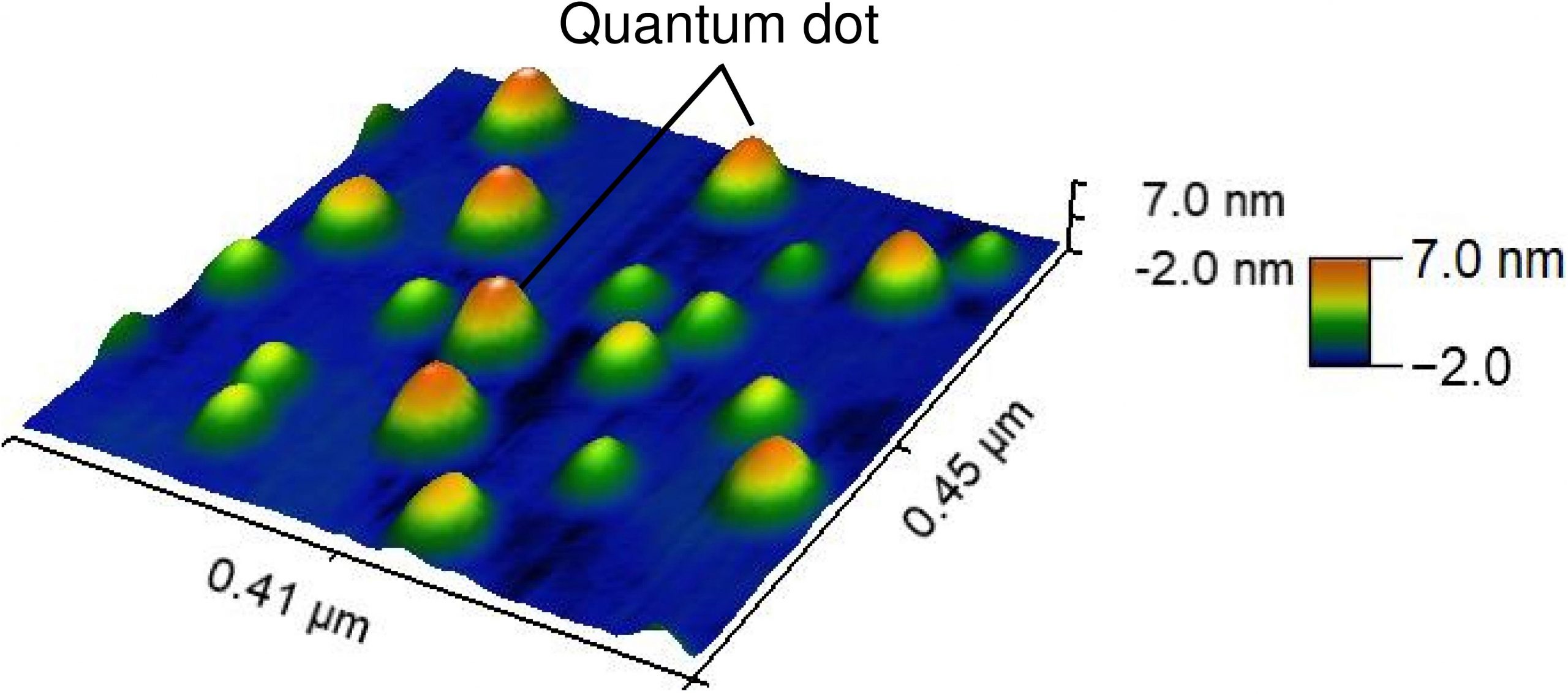
Researchers at Linköping University, Tampere University and Hokkaido University have now achieved an electron spin polarization at room temperature greater than 90%. The spin polarization remains at a high level even up to 110 °C. This technological advance, which is described in Nature Photonics, is based on an opto-spintronic nanostructure that the researchers have constructed from layers of different semiconductor materials (see description below the article). It contains nanoscale regions called quantum dots. Each quantum dot is around 10,000 times smaller than the thickness of a human hair.

Quantum Dots Opto-Spintronic Nanostructure

The quantum dots in the opto-spintronic nanostructure are made from indium arsenide (InAs). Each quantum dot is around 10,000 times smaller than the thickness of a human hair. Credit: Yuqing Huang

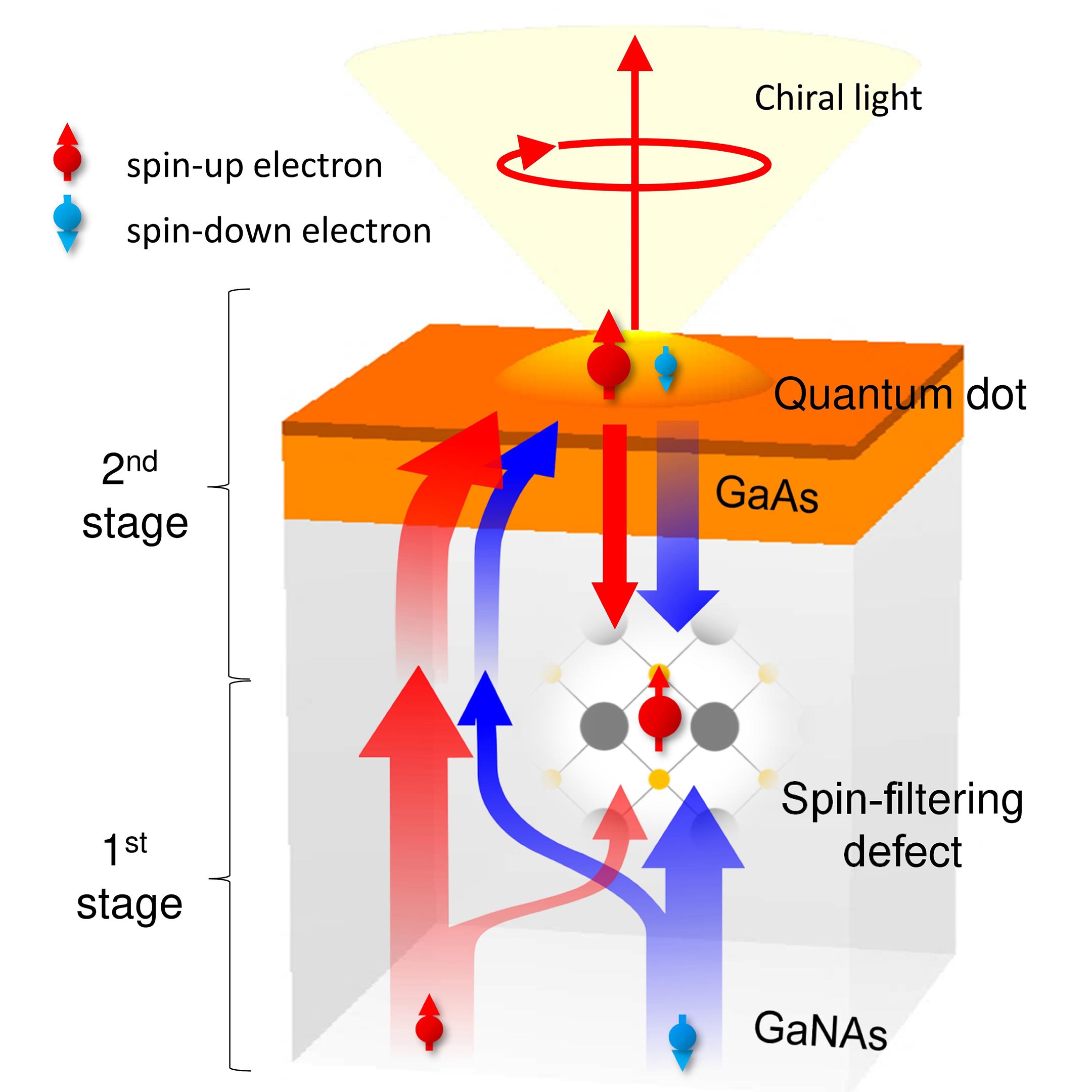
When a spin polarized electron impinges on a quantum dot, it emits light – to be more precise, it emits a single photon with a state (angular momentum) determined by the electron spin. Thus, quantum dots are considered to have a great potential as an interface to transfer information between electron spin and light, as will be necessary in spintronics, photonics and quantum computing. In the newly published study, the scientists show that it is possible to use an adjacent spin filter to control the electron spin of the quantum dots remotely, and at room temperature.

The quantum dots are made from indium arsenide (InAs), and a layer of gallium nitrogen arsenide (GaNAs) functions as a filter of spin. A layer of gallium arsenide (GaAs) is sandwiched between them. Similar structures are already being used in optoelectronic technology based on gallium arsenide, and the researchers believe that this can make it easier to integrate spintronics with existing electronic and photonic components.

“We are very happy that our long-term efforts to increase the expertise required to fabricate highly-controlled N-containing semiconductors is defining a new frontier in spintronics. So far, we have had a good level of success when using such materials for optoelectronics devices, most recently in high-efficiency solar-cells and laser diodes. Now we are looking forward to continuing this work and to unite photonics and spintronics, using a common platform for light-based and spin-based quantum technology”, says Professor Mircea Guina, head of the research team at Tampere University in Finland.


What is spintronics?

Spintronics is a technology that uses both the charge and the spin of electrons to process and carry information.

The spin of an electron can be envisioned as arising when the electron rotates clockwise or anticlockwise around its axis, in the same way that the Earth rotates around its axis. The two directions of rotation are called “up” and “down”. In the electronic technology used today, the electron charge is used to represent 0 and 1, and in this way carry information. In a corresponding way, the information can be represented in spintronics using the spin state of the electrons.

Illustration of Opto-Spintronic Nanostructure

In the opto-spintronic nanostructure, an electron spin polarization degree greater than 90% is achieved at room temperature in a quantum dot, via remote defect-enabled spin filtering through an adjacent layer of gallium nitrogen arsenide (GaNAs). When such a spin polarized electron recombines, it emits chiral light. The spin state of the electron determines whether the electromagnetic field of the light will rotate clockwise or anticlockwise around the direction of travel. Credit: Yuqing Huang

In the world of quantum physics, an electron can possess both directions of spin at the same time (and thus be in a state that is a mixture of 1 and 0). This is, of course, completely unthinkable in the traditional, “classical” world, and is the key to quantum computing. Spintronics is therefore promising for the development of quantum computers.

Opto-spintronics involves transferring the information that is represented by the spin state of the electrons to light, and vice versa. The light, photons, can then carry the information onwards through optical fibers, very rapidly and across long distances. The spin state of the electron determines the properties of the light, or to put it more accurately, it determines whether the electromagnetic field of the light will rotate clockwise or anticlockwise around the direction of travel, in roughly the same way that a corkscrew can have a clockwise or anticlockwise direction of turn.

Source: Weimin Chen, professor at Linköping University


Reference: “Room-temperature electron spin polarization exceeding 90% in an opto-spintronic semiconductor nanostructure via remote spin filtering” by Yuqing Huang, Ville Polojärvi, Satoshi Hiura, Pontus Höjer, Arto Aho, Riku Isoaho, Teemu Hakkarainen, Mircea Guina, Shino Sato, Junichi Takayama, Akihiro Murayama, Irina A. Buyanova and Weimin M. Chen, 8 April 2021, Nature Photonics.
DOI: 10.1038/s41566-021-00786-y

Financial support for the research has been granted by, among other bodies, the Swedish Research Council, the Swedish Foundation for International Cooperation in Research and Higher Education (STINT), the Swedish Government Strategic Research Area in Materials Science on Functional Materials at Linköping University, the European Research Council ERC, the Academy of Finland, and the Japan Society for the Promotion of Science.

Sunday, April 18, 2021

BBC : Facebook jeopardizes ongoing work to tackle child abuse, by his plans to deploy encryption in its messaging services

Facebook's plans to roll out encryption across its messaging services could jeopardise ongoing work to combat child abuse, the Home Secretary is to warn.

Such encryption means only the sender and recipient can read messages.

"We cannot allow a situation where law enforcement's ability to tackle abhorrent criminal acts and protect victims is severely hampered," Priti Patel will tell a charity-hosted event.

Facebook says its plans for wider encryption protects users' privacy.

The National Society for the Prevention of Cruelty to Children (NSPCC), which invited Ms Patel to speak, has claimed that private messaging "is the frontline of child sexual abuse".

Encrypting messages by default could lead to the easier spread of child abuse imagery or online grooming, it has said.

In her speech, the Home Secretary is expected to demand that Facebook does more to take into account public safety when it makes changes to its platform - and in particular seriously consider the effect on children.

She will say: "Sadly, at a time when we need to be taking more action, Facebook are pursuing end-to-end encryption plans that place the good work and progress achieved so far [on fighting the issue of child abuse] in jeopardy.

"The offending will continue, the images of children being abused will proliferate - but the company intends to blind itself to this problem through end-to-end encryption which prevents all access to messaging content."

"This is not acceptable."

'Scrambled' messages

The minister will tell a group of international experts in child protection and law enforcement that Facebook must "take the safety of children as seriously as they do the business of selling advertising, phones and online games".

End-to-end encryption guarantees privacy by making sure only the sender or recipient can read the messages.

While it travels, it is scrambled to be unreadable, including by law enforcement. The only way to read the message is usually to get physical access to an unlocked device receiving it.

Currently, only one of Facebook's major messaging platforms - WhatsApp - uses end-to-end encryption by default. The company has plans to make the privacy feature the norm on Facebook Messenger and Instagram - but has not yet done so.

When messaging platforms are not end-to-end encrypted, tech giants such as Facebook can use automatic scanning of their users' posts to identify the sharing of known child abuse images and detect questionable use of private messaging - such as an older person chatting to underage users they do not already know.


The NSPCC argues that rolling out the encryption as planned would "render these [scanning] tools useless", and is calling on Facebook to reconsider. An estimate from the US National Center for Missing and Exploited children suggests as many as 70% of child abuse reports around the world could be lost if it goes ahead.

The NPSCC says it will unveil research that suggests social media users are keen to see some guarantee that children's safety will be protected.

The charity is demanding a "reset" of the debate, arguing that it has become stuck as an "either/or" debate between personal privacy and child safety.

Instead, it is calling for a "balanced" solution that protects both.

But no clear solution to satisfy both sides currently exists. Other possible solutions, such as on-device software that scans messages before they are sent, have their own privacy concerns.

Encryption still 'popular'

Gaining access to the content of encrypted messages has long been a topic of debate in government.

One of Ms Patel's predecessors, Amber Rudd, argued in the wake of the 2017 Westminster attack that "we need to make sure that our intelligence services have the ability to get into... encrypted WhatsApp".

And former Prime Minister David Cameron, in the wake of the 2015 Paris attacks, declared that there should be no "means of communication" which "we cannot read".

Despite such concerns, encrypted messaging remains a sensitive topic with much public support.

Jim Killock, executive director of the Open Rights Group, said: "Encryption is popular and growing because users want security and protection from fraud, scams and abuse of their data."

"It would be completely unreasonable to ban or limit everyday security for one set of people over the other.

"It is absolutely necessary to deal with child abuse images, but solutions must be compatible with people's right to keep themselves safe from other kinds of criminality, so should move away from endlessly debating how to stop the use of encryption."

But Sir Peter Wanless, NSPCC chief executive, argued that view risked "leaving children unprotected where there is most harm".

"It's in firms' interests to find a fix that allows them to continue to use tech to disrupt abuse in an end-to-end encrypted world," he added.

And he said that if the tech giants failed to do so, "ultimately government must be the guardrail" to protect children.

Facebook has long defended its plans to introduce end-to-end encryption as essential to user privacy and to protect people from hackers and criminals. The company has yet to comment on Ms Patel's expected remarks.


What will the world really look like in 10 years time


Big demographic, economic and technological changes are coming — from an aging population in the U.S. and the rise of sub-Saharan Africa as a compelling middle-class market to automation causing “technological unemployment,” according to Wharton management professor .

                                                                                                                                                Mauro Guillen.


Big demographic, economic and technological changes are coming — from an aging population in the U.S. and the rise of sub-Saharan Africa as a compelling middle-class market to automation causing “technological unemployment,” according to Wharton management professor Mauro Guillen.

In his new book, “2030: How Today’s Biggest Trends Will Collide and Reshape the Future of Everything,” Guillen discusses how these changes will affect us in the years to come. During a recent interview on the Wharton Business Daily show on SiriusXM, Guillen noted that while these trends have been gathering pace for years, the pandemic is accelerating many of them. (Listen to the podcast above.) Rising inequality across income, race and gender will demand urgent attention, and government policy making will need to become more innovative to address such challenges. Individual responsibility will play a role, too, in areas such as climate change, he says.

An edited transcript of the conversation follows.

Wharton Business Daily: Why did you write this book?

Mauro Guillen: Everyone sees change everywhere, and I think it’s important to figure out where are we going to be five to 10 years from now. How are consumer markets going to look? It’s extremely important for businesses and also for individuals – as investors, as savers and more generally as citizens – to figure out what the future’s going to look like.

Wharton Business Daily: What role has the pandemic played in that change?

Guillen: The pandemic essentially has two different effects, depending on the trend. One is to accelerate and to intensify some things. For example, consider population aging. Inevitably in a recession, we have fewer babies. The mere postponement of having babies accelerates population aging, so problems related to Social Security and pensions will arrive earlier. Other types of trends get delayed, or even reversed, by something like this. One of them will be the growth of cities, especially in Europe and in the U.S.

“We’re going to have to think very carefully in political terms and in social terms about the implications of further automation, especially in the service sector.”

Wharton Business Daily: North America, Europe and Asia have been vital in the last several decades, but you talk about other areas of the world picking up and having a larger impact in the years ahead.

Guillen: I am very bullish on sub-Saharan Africa because of their demographic dynamism, and because the biggest cities in Africa are growing and creating an expanding middle class. Now, only maybe 15% of the sub-Saharan African population is middle class. But that proportion is growing. That will change the world, because Africa will soon become the second most populous region in the world.

Coming Shifts in Technology

Wharton Business Daily: What significant changes do you see in terms of technology?

Guillen: As a result of the pandemic, technology adoption has been progressing much faster, out of necessity. We’ve been confined to the home, students cannot attend school and so on and so forth. But we also need to watch carefully the new incentives for automation, especially in the service sector, that this public health crisis creates.

We’re going to see more automation. We’re going to see, unfortunately, more technological unemployment. Many other jobs have been lost in the American economy. I don’t think they’re coming back. We’re going to have to think very carefully in political terms and in social terms about the implications of further automation, especially in the service sector.

Wharton Business Daily: Would the increased emphasis on automation also influence policymaking and education?

Guillen: Yes. In terms of policy making, we have to figure out how to retrain people and how to help those people find other jobs. We may have to consider very seriously ideas such as a universal basic income, which you have discussed on your show on several occasions. This used to be a fringe idea, but it’s quickly becoming more mainstream.

Wharton Business Daily: We’ve seen a little bit of that here in the U.S. with the $1,200 stimulus checks that were part of a $2.2 trillion package of coronavirus relief measures. But what you’re talking about concerns how governments look out for their citizenry, correct?

Guillen: Exactly. It’s not just about being nice to people, which I think we should be. But universal basic income also has a business case. Remember, two-thirds of the American economy is [made up of household] consumption. If people don’t have jobs or don’t have well-paying jobs, then we need to compensate for that.

Wharton Business Daily: You also focus on how currencies may change. To a degree, we’ve already seen that with bitcoin.

Guillen: Yes, we need to seriously consider how entrepreneurs can come up with new ideas as to what cryptocurrencies, or to be more precise, crypto tokens, will be used for.

I hope that the two presidential candidates start debating exactly how they’re going to deal with increasing inequality.

 If cryptocurrencies are just a substitute for the money that governments issue, then I don’t think we’re going to get too far because our regulators are always against cryptocurrencies as a competitor for legal tender.

But if we add other functions or other uses to those digital tokens — like if they will help us vote, keep politicians in check or provide incentives for people to save the environment — then there is a bright future ahead for digital tokens. So instead of digital currency, I would say digital tokens, which would include a currency component to them.

Inequality: The Next Frontier

Wharton Business Daily: How do we address the wealth gap?

Guillen: That’s a huge development of the last 20 years, and the pandemic only exacerbates inequality. Not everyone can work from the home, and therefore they have to expose themselves to the virus while taking public transportation to go to work. Consider students. It is estimated that up to 20% of K-12 students in the U.S. don’t have the hardware or the connectivity that they need at home in order to continue school work. This is the most unfortunate part of this pandemic, and it exacerbates inequality based on income and race.

That is true even by gender. Unemployment is growing faster among women than men. So, this is something that we need to pay attention to. I hope that the two presidential candidates start debating exactly how they’re going to deal with this increasing inequality.

Wharton Business Daily: Are we ready to tackle these issues?

Guillen: There is increasing awareness, but I guess we will have to wait until after the presidential election. But whoever happens to be in the White House and whoever controls the Senate come January, I don’t think they will be able to ignore the issue of inequality. We’re seeing social tensions and all sorts of frictions proliferate. The sooner we start tackling it, the better.

Wharton Business Daily: People are worried about various individual issues. But should the emphasis be on changing the overall mindset about how we want our world to look in 2030?

“We’re seeing social tensions and all sorts of frictions proliferate. The sooner we start tackling it, the better.”

Guillen: I do believe so. For example, many parents are now concerned about whether their children will be able to have the kind of life that they have been able to have. The way things are going, maybe only a small fraction of them will do better than their parents.

Here in the U.S., one of the single most important values that we have is that we want every generation to do better than the previous one. And this is becoming increasingly difficult. Millennials right now are suffering from — for a second time during their adult lifetimes — a very difficult labor market.

There’s more consciousness and awareness of this, and the culture will need to adjust in terms of revisiting some of our values.

Wharton Business Daily: How will the mindset of governments and policymakers need to change?

Guillen: The time has come to be a little bit more innovative, to explore things in terms of government policy making that 10, 20 years ago we thought were completely out of bounds. The problems have become so large. By the way, we haven’t even talked about climate change. We really need to start thinking outside of the box.

Wharton Business Daily: What should we be doing?

Guillen: We need to focus on two things. One is international collaboration among governments when it comes to climate change, but also in other areas like trade, where it is completely absent right now. The second one, which is the one that I push in my book, is we as individuals need to take ownership of this. We need to be less wasteful. We need to economize our resources. We need to be more pro-environment in our own behavior as consumers.


Hackerspace